
Can Brazilian biological inputs really work in North American soils?
The real reason foreign biologicals fail in North America is something we can fix.
Can Brazilian biological inputs really work in North American soils?
We may be asking the wrong question. Instead of "Can Brazilian biological inputs work in North America?" we should be asking "How do we raise the probability that beneficial microbes establish and perform in a new environment?"
I keep hearing that Brazilian biologicals can't work in North American agricultural soils because it's too cold, the soil is different, and many past trials didn't work.
The basic agronomic principle is that we sow crops at times of year when it's warm enough to stimulate seed germination, when the photoperiod is ideal, and when there are enough nutrients for roots to grow and develop. Spring and summer soil temperatures across North America are warm enough for plants to germinate and microbes to thrive. And agricultural soils are a matrix where plants can grow. They are not extreme environments. I believe that intelligently designed formulations, higher viable-cell delivery, and strategic management could significantly improve establishment, regardless of where a microorganism originated.
I wonder if the products brought to North America in the past landed alive. Was the product properly formulated to survive the travel and protect the microorganisms after they are placed in foreign soil? Were they validated in several field trials in their origin country, for the same crops they were being recommended for? Was it properly prepared on the farm and applied at the right time, certainly not during the winter?
Given the scale of impact that proven Brazilian biological products could bring to North American agriculture, the real work is not deciding whether they belong. It is making them feasible, by adjusting the factors that change a microbe's perception of comfort.
Biology is complex. But perhaps geography isn't the main barrier.
A few things to consider about the agricultural soil microbial community. Because every gram of soil contains several thousand species, we can begin to imagine how many metabolic pathways are constantly switching on and off as organisms survive the contest for carbon and nutrients. The microbial dynamics we observe in any agricultural soil are the product of nutrient availability, ecological interaction, environmental conditions, and land management. Plant and soil microbiomes interact continuously with the soil matrix, under specific environmental conditions, alongside different plant species with different root architectures.
From that view, the factors that matter are:
- Survival after application
- Competition with native microbes
- Formulation quality and cellular protection
- Carbon sources, nitrogen, and phosphorus availability during establishment
- Soil conditions and management practices
- Repeated inoculation over time
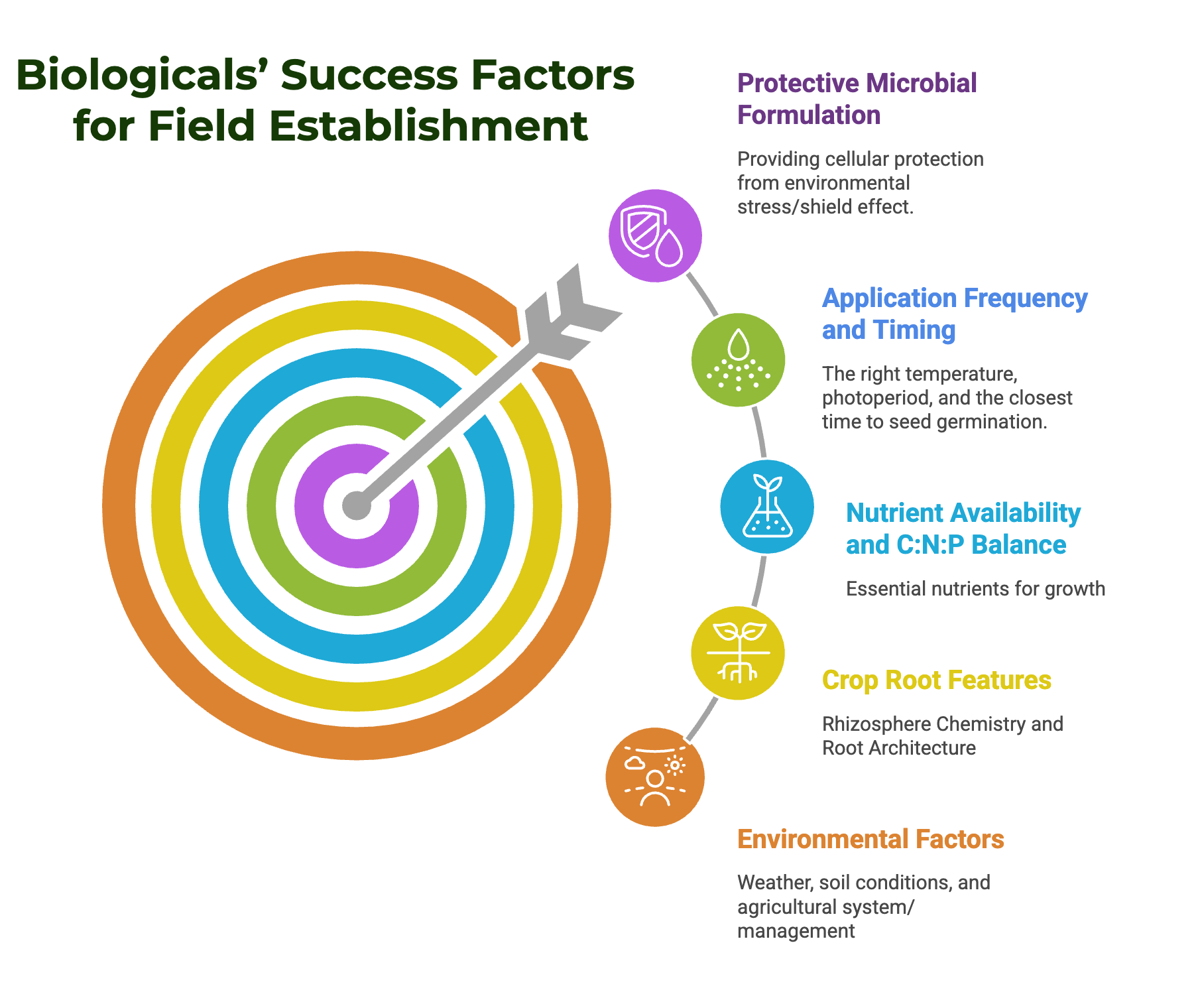
Performance variability arises because introduced microbes must establish themselves inside highly competitive resident communities, under a new environmental context.
So the challenge is not the organism's country of origin, but whether an introduced microbe can establish itself inside a highly competitive soil ecosystem. Wherever it came from, it still faces the same gauntlet: competition, predation, nutrient limitation, environmental stress, and ecological exclusion. In agricultural soils, that establishment is a problem we may be able to engineer toward, and the one we have built our work around.
Perhaps biologicals can survive and benefit crops in another country, if some aspects are addressed:
- They are tested enough in the field in their country of origin (multi-year trials, different soil types) and validated.
- They are inoculated in the same crop species they were tested for, with similar root chemistry (root architecture, rhizosphere exudates such as sugars and metabolites).
- They carry a proper adaptive, protective formulation. A product built with ingredients that increase cellular protection and help regulate the C:N:P ratio around the cell may raise the probability of survival during that critical establishment window.
- Inoculation is repeated annually, sometimes twice in a season when conditions call for it. Increasing the number of viable cells delivered may improve an organism's ability to compete against native species, particularly when paired with intelligent formulation design.
If these products have struggled in North America before, perhaps it was never proof that they could not work here. Perhaps it was proof that we had been asking the wrong question all along, and that the right one is finally within our power to answer.
By Dr. Patrícia Dörr de Quadros
Soil microbiologist and founder of Quadros Bio.
Patrícia Dörr de Quadros, PhD, Founder and CEO, Quadros Bio Inc. Commentary and informational only, not investment or legal advice.